顯示具有 English Articles 標籤的文章。 顯示所有文章

2025年7月12日 星期六

The Fracturing of the Symbolic Order: A Review of The Islands and The Making of Crime Scenes

Originally published in Taipei Documentary Filmmakers’ Union Newsletters (紀工報), Issue 56 (2022.05.19)

BY Mr. GeckoBiHu

(This English version of the article you're now reading is translated by myself, on July 13, 2025)


The Islands: Secretly A Comedy

Following The Right Thing (2010) (廣場), which documented the Wild Strawberry Movement (野草莓運動), and The Edge of Night (2018) (街頭), a close-up on key members of the Sunflower Movement (太陽花學運), Chiang Wei-Hua’s new documentary The Islands (2022) (島.國) accompanies young political activist Chen Ting-Hao, one of the Sunflower Student Movement’s core members, as he begins his post-movement political work in the Matsu Islands, probing deeper and more directly toward the core of the imagined community that is Taiwan/Republic of China, while also indirectly observing the pondering ripple effect (or the lack there of) of the movement.

Having served his conscription military service in Matsu Islands, Chen decided to see “conducting political work on the Islands” as the imaginary goal of his social practice. And so the “Taiwan as an independent country” identified Chen and the Matsu Islands’ symbolically charged landscape full of “Republic of China-identified symbolism” forms an exquisite chemical reaction, as everywhere we go, we see all sorts of materialisation of the Symbolic Order “flaking off” from the edge of it. This is why filming Chen doing even the most whatever mundane task is not the least bit boring, because no matter it’s just him picking up trash on Matsu’s beachfront, finding cellphone single (which constantly switches between Taiwanese and Chinese companies due to the proximity of geography), sawing the tip of the R.O.C flagpole, introducing abandoned bunkers to tourists, knocking down layers of thick paint off defunct military buildings or chatting with local children, the threefold boundaries of Symbolic Order lying on top of each other (the boundaries of R.O.C./ Chen’s “Republic of Taiwan,” Matsu as a dominantly “blue-leaning over green” island (pro-KMT over DPP), and the islands as literal border against People’s Republic of China across the strait) continuously “flake off” from the symbolic “country/nation” into the material world — like the flaking off paint.

2025年6月7日 星期六

An Initial Exploration of Carto: the World as the Act of Appearing


By MrGeckoBiHu(壁虎先生)

(This review was originally published in Traditional Chinese on January 10, 2022 in a printed Taiwanese Newspaper The Affairs(The Affairs 週刊編集) Issue No. 54, and later published on their official website)(You may find the full original texts here)


(This English version of the article you're now reading is translated by myself, on June 8, 2025)


In Hellblade: Senua's Sacrifice, there is a level in which the Celtic warrior Senua enters the domain of the malevolent spirit Valravn. There, things are not what they seem. Amid the smoky forest, inside the maze of the crumbling stone ruins, are wooden archways on which shamanic totems and skeletons hang. And the player will gradually discover that, passing through these gates in a specific sequence and direction, will cause bridges to materialize out of thin air just as the wooden posts of the archway slice across the screen, and the stone walls previously blocking our way and the shamanic totems previously hung on trees disappearing. It is as if we just step into a "space rupture," as if we have skipped over a portion of reality. You can even step back from the "frame" formed by these archways and, from a different angle, perceive the "discontinuity" and "rupture of the scene" inside and outside of the archway frame, like viewing a scene through a shattered glass pane, or an image that’s been inaccurately reassembled with tapes after being torn apart. However, if you did not pass through or arrive at these archways in a particular sequence, just walk through them spontaneously or randomly, then nothing extraordinary will be registered by our senses about these archways, no different from an ordinary archway. They stop being the "rupture point" of the scenery, even passing through them back and forth continuously, we would not have perceived any discontinuation in space, these become mere man-made objects, and the "rupture" of space that just now appeared, miraculously disappeared.

Now, imagine that we are both Valravn and Senua, and we hold a magical map capable of manipulating the spatial reality around Senua. This is precisely what in Carto, an 2020 indie game made by Taiwanese studio Sunhead Games, our young little girl protagonist Carto was doing. Living aboard an airship high in the sky, Carto's cartographer grandmother possesses a magical map. And through reassembling pieces of this map in a puzzle-like manner, the appearance of the world itself changes in response. One day, in a mischievous mistake, Carto, who lives abroad with her grandma, accidentally causes the ship to be struck by lightning, falling onto the surface world below, and is separated from her grandmother. But she still holds a fragment of that magic map in hand, so she sets out on a journey to find a way to reunite with her grandma.

On our first stop in Carto, a small fishing island, Carto's first mission immediately showcases the game's magical core mechanic in an elegant and concise way: An absentminded old fisherman stands by the shore, describing to Carto his home on the east shore, but he's forgotten where east is and how to get home. When Carto unfolds her map, we see a series of tile pieces within each a certain pattern of natural terrain was drawn, and are randomly pieced together, forming a "seemingly incomplete" landscape (each tile contains up to two types of terrain). The player can see Carto and some other characters' locations on the map, however the player will soon realize that this island does not have an east coastline, in fact the tiles never extend there, that area is "lacking out of bounds" on the map. So, the player selects the tile containing Carto and the fisherman, rotates, moves and connects it to the east side of the map. And when the terrain aligns, a house then "materializes itself out of thin air" on the tile. Closing the map, we find that Carto and the fisherman now "already are" standing next to his seaside home, then the old fisherman thanks you for "guiding" him home.

2025年6月5日 星期四

About Mr. GeckoBiHu 關於壁虎先生 for English Readers


電影和遊戲評論寫作,現居台灣。文章散見《幼獅文藝》、《紀工報》、《The Affairs 週刊編集》、《放映週報》、《關鍵評論網》、《Fa電影欣賞》、《映畫手民》、Blogger、Medium等刊物平台。

I'm a freelance film/ video game critic and columnist based in Taiwan under the pen name Mr. GeckoBiHu (壁虎先生). I mainly writing in Mandarin (Chinese Tradition, although I've translated a few of my work in English myself, though not much), and have been proving film and video game reviews and articles to various Taiwanese media outlets, magazines and journals since 2017.

Most recently wrote as a columnist on the Taipei Documentary Filmmakers' Union Newsletters(紀工報) from 2021 to 2024, which is the official digital publication of Taipei Documentary Filmmakers' Union (臺北市紀錄片從業人員職業工會). Other works includes a one year column on the historic Taiwanese literary journal Youth Literary (幼獅文藝) in 2023 (before its closure at the end of that year), providing film and video game reviews and proses, and a column on the hard copy Taiwanese newspaper The Affairs (The Affairs週刊編集) from 2019 to 2022.

You can also find some of my work at Taiwanese news outlet TNL The News Lens (關鍵評論網), udn opinion (鳴人堂) (which shut down at 2023, although the webpage is still up) and Hong Kong film critic website Cinezen (映畫手民) (which shut down in 2024), and the long time running film website Funscreen (放映週報) and Fa Film appreciation journal (Fa電影欣賞), which are the official publications of the Taiwan Film and Audiovisual Institute.

Additionally, he's a member of the Taiwan Film Critics Society(台灣影評人協會), and was invited by the 14th Taiwan International Documentary Festival (台灣國際紀錄片影展, also known as TIDF), as a jury member of the Taiwan Film Critics Society Prize among other Critics Society members.

You may contact me or find my work through the following method:

Contact: mrgeckobihu@gmail.com 

Facebook Page(mainly active):https://www.facebook.com/MrGeckoBiHu

Medium(where you can find all my articles): https://medium.com/mrgeckobihu

Blogger(alternative to Medium, also includes all my articles): https://mrgeckopapa.blogspot.com/

X/Twitter:https://twitter.com/MrGeckoBiHu

YouTube Channel(sometimes stream my gameplay)::https://www.youtube.com/@mrgeckobihu4365

Twitch(not currently active):https://www.twitch.tv/mrgeckobihu

2025年2月3日 星期一

Tsai Ming-liang's Where: A Reunion in a Dream

Tsai Ming-liang's Where: A Reunion in a Dream


By MrGeckoBiHu(壁虎先生)
 (This review was originally published in the 62nd issue of Taipei Documentary Filmmakers' Union Newsletters(紀工報) on February 7, 2024)

(This English version of the article you’re now reading is translated by myself, on February 2, 2025)


Before discussing Tsai Ming-liang's new work Where (2022), it’s hard not to first reveal that I think Where is secretly a fiction film. However, not only do I not mind its nomination for the Best Documentary Feature at the Golden Horse Awards, I also believe that this is ultimately not very important. What I mean is that the Golden Horse Awards and the categorization of a film’s genres exist separately, outside of this film, if not all films’ existence. I will also mention later how Where can also be entirely read as a documentary in the most conservative sense. So maybe I should put it this way, that the most moving reading of this film for me, is when it’s interpreted as a fiction, and there’s nothing wrong about the Golden Horse Awards considering it as a documentary. In fact, I don’t feel like it affects my legitimacy to comment on such a film in the Taipei Documentary Filmmakers' Union Newsletters at all, even if I consider it as a fiction or write about a reading that reads it as a fiction in this article. My subject is, after all, a film “that’s nominated for the Best Documentary Feature at the Golden Horse Awards.” On the contrary, it actually becomes meaningful for this very reason. I want to make this point clear at the start.

Next, I would like to summarize my general understanding of the background of the “Walker” series: In 2011, Tsai Ming-liang directed a stage play Only You (which I didn’t have the chance to see), in which choreographer Cheng Tsung-lung devised a movement for Lee Kang-sheng to walk across the stage at a very slow pace. This deeply moved Tsai Ming-liang, and this became the prototype of the “Walker.”[1] In 2012, Tsai Ming-liang designed the image of Xuanzang in a red robe for Lee Kang-sheng, and let him walk at an extremely slow pace, hands sustaining the lotus gesture, bowing his head, as he walked in various locations. That year, he directed four short films on this theme all at once. Among these four films from 2012, the first seems to be No Form (2012), but the only one I have had the opportunity to see is Walker, which is a segment in the four-part feature film Beautiful 2012 (2012) commissioned by the Hong Kong International Film Festival. This seems to be the second film piece in the series. (In Walker, Lee Kang-sheng slowly struggles through the streets of Hong Kong from daylight till the night falls, but there is one aspect that differs from other works in the series: a bag of takeout food hung on one of Xuanzang’s hand and a hamburger was held by the other, and the film ends with Lee Kang-sheng slowly starting to eat the hamburger.)

Joker: Folie À Deux: The Name of the Plague

 Joker: Folie À Deux: The Name of the Plague

★★★★(4/5)

By MrGeckoBiHu (壁虎先生)


(This review was originally published in Traditional Chinese on October 7, 2024 on MrGeckoBiHu’s Blogger, Medium and Facebook page simultaneously)


(This English version of the article you’re now reading is translated by myself, on February 2, 2025)


(This review includes spoilers and the ending of the film)


What we are witnessing in real-time right now to Joker: Folie À Deux, is probably the closest thing our generation will ever see to what Twin Peaks: Fire Walk with Me was and the criticisms it faced back then. As a sequel that’s meticulously designed to confront and deconstruct the success of its predecessor——Twin Peaks/ Joker: The former became a phenomenal ratings success in American television history, with David Lynch winning the Palme d'Or in the same year for Wild at Heart; the latter, after being award the Golden Lion, achieved widespread audience acclaim, with global box office earnings exceeding one billion dollars—— in the most unflinching way, Todd Phillips is attempting with Joker: Folie à Deux what Lynch once did with Twin Peaks: Fire Walk with Me, and as a result, has garnered an equivalent amount of attack and ridicule(Twin Peaks: Fire Walk with Me became a laughingstock amidst boos after its Cannes notorious premiere, and Lynch was treated like a pariah): In the collision of negative matter, the appealing facade of the predecessor is dismantled, in an effort to illuminate their works’ original tragedies and within, the unsettling, uncomfortable restlessness, fragmentation, and instability that disturb the audience. They tear apart their previous work in an attempt to rescue their protagonists—— Laura Palmer in Twin Peaks: Fire Walk with Me, and Arthur Fleck in Joker: Folie à Deux——from their own catastrophic success.


And just as its character who tragically misrecognized his own identity, Arthur Fleck's face is gradually replaced and forgotten in the mythologizing process (through countless reproductions of decontextualized memes), by the makeup he originally wore. Joker: Folie à Deux thus serves as a traumatic de-mythologizing ritual, brutally and uncomfortably exposing the mythologizing process itself, reminding the audience that Joker is a tragedy—Arthur Fleck's tragedy—where he is like Pvt. Pyle from Full Metal Jacket, and the “Joker” is not the protagonist but the “name of a plague” that descended upon its protagonist. Henceforth, when audiences furiously spit on and accuse Todd of ruining everything that was good about his previous film, Todd responds “No, no, no, it's you who forgot what happened in the previous movie. You did not realize who Arthur was.’’

Joker: The Myth of Arthur Fleck


Joker: The Myth of Arthur Fleck

The final shot of Joker (2019)

The final shot of Monsieur Verdoux (1947)

The final shot of Modern Times (1936)


By MrGeckoBiHu(壁虎先生)

(This review was originally published in Traditional Chinese on November 10, 2019 in a printed Taiwanese Newspaper The Affairs(The Affairs 週刊編集) Issue No. 29, and later published on their official websites)(You may find the full original texts here)


(This English version of the article you’re now reading is translated by myself, on February 2, 2025)


The inclusion of "Smile", sung by Jimmy Durante, during the dating scene between Arthur Fleck and his neighbor Sophie is particularly cruel. This song is adapted from a score that Charlie Chaplin personally composed for Modern Times (1936). In the film, when Chaplin's Tramp and Paulette Goddard's character dream about escaping their miserable fate and living a middle-class life during the Great Depression, the score evokes their innocence while gently reminding the audience that they still have each other. In this scene, Sophie refers to the Joker from the subway murder as a “hero,” while Fleck happily tries to squeeze out his own grin, seeing his reflection in a speeding taxi. Smile becomes an obvious omen, and we later discover that this seemingly too-good relationship is just a bubble occurring in Fleck's mind.

However, while the presence of the Tramp in Joker is self-evident, the even more significant presence of Chaplin's Monsieur Verdoux (1947) has been completely forgotten by American critics, to the point that, over seventy years later, they almost unconsciously repeat the same hysteria that surrounded the film at the time. Yet, as André Bazin brilliantly tells us in “The Myth of Monsieur Verdoux,”[1] it is through the image of this former bank clerk who continuously murders wealthy women for profit that the myth of the Tramp reaches its logical conclusion by presenting his opposite. Therefore, if you are surprised that Todd Phillips merges Chaplin's Tramp with a socially provocative murderer, it's worth noting that Chaplin himself had already done so. Is not Monsieur Verdoux's Raskolnikov-like cynicism precisely what society “deserves?”[2]

2024年12月10日 星期二

散步的好日子:評林亭聿個展〈Bark! Bark! Hello! This is lucky. It’s true. 〉
/A Fine Day for a Walk: Review of Lin Ting-Yu's Solo Exhibition Bark! Bark! Hello! This is lucky. It’s true. (English Version of the Article Below)


文/壁虎先生
(本文寫於2023年1月,同時刊登於林亭聿個人網站)

2022年1月24日 星期一

Gun Smoke, IGNIS FATUUS, and Bodhi: Exploratory Study on yeo's Work of Genius "Arrest of a stone Buddha"

By Mr. GeckoBiHu

(scroll down below for more information about this article and the author)


In 2018, a genius game developer named “yeo” living in Moscow broke into the gaming sphere with his 8-bit retro style beat'em up RPG The friends of Ringo Ishikawa. About a rebellious Japanese high school student Ringo and his friends’ last autumn as high school students, it’s like the Kunio-kun series are modernized, but in a reverse gesture, by introducing concepts of “passing time” and the “elimination of objectives”, brings an unresolvable sadness of being into this old genre. Most of the time in this game, except for some key plot points, we are not forced to complete any objectives. The game won’t even teach you how to play it. You can go to class, have small talk with your mate on the school roof, pick some other school students with different color uniforms to fight randomly on the streets, go to the gym to train yourself, or miss everything mentioned above entirely and just wander around the streets. You can smoke a cigarette on a park bench in the middle of the night, or you can eat nothing but will never “starve to death”; You can just sit on your bed “playing video games”, or just do absolutely nothing, and time just passes through your eyes. In most sectors of the game, the progression system is “objective-free”, time itself becomes the progression. So you can also go to the bookstore, buy a book and “read” it, for example, “FD’ Brother”– a naughty reference of Fyodor Dostoevsky's The Brothers Karamazov– but you won’t actually “read it”. You just press a button, and see Ringo’s gesture of  holding the book and the numbers indicating pages running. And when the number reaches the end, see Ringo’s one line remark on it. The “time” you “press the button” is the “time” you “read”, although we don’t actually “read” anything. So even we are still left with various activities to do and can be content with completing each of them in-game, but the openness, the aimlessness and the irreversibility of time cause a consistent uncertainty within the game itself and swing the player in it. That’s also why when the game ends, when the friends of Ringo Ishikawa, the gang who fought alongside him in the park at the beginning of the game, start to walk their separate ways, leaving behind Ringo Ishikawa alone on the platform in the rain, fighting waves and waves of enemies, we can not help but notice an emotion gut punch coming in: Oh! I am disappearing! It is just like what Roy Batty said at the end of Blade Runner. The black fades in, and Ringo’s unreadable 8-bit face starts to disappear in the rain in front of us, like tears in the rain.


Jean-Pierre Melville, John Woo and Louis Malle


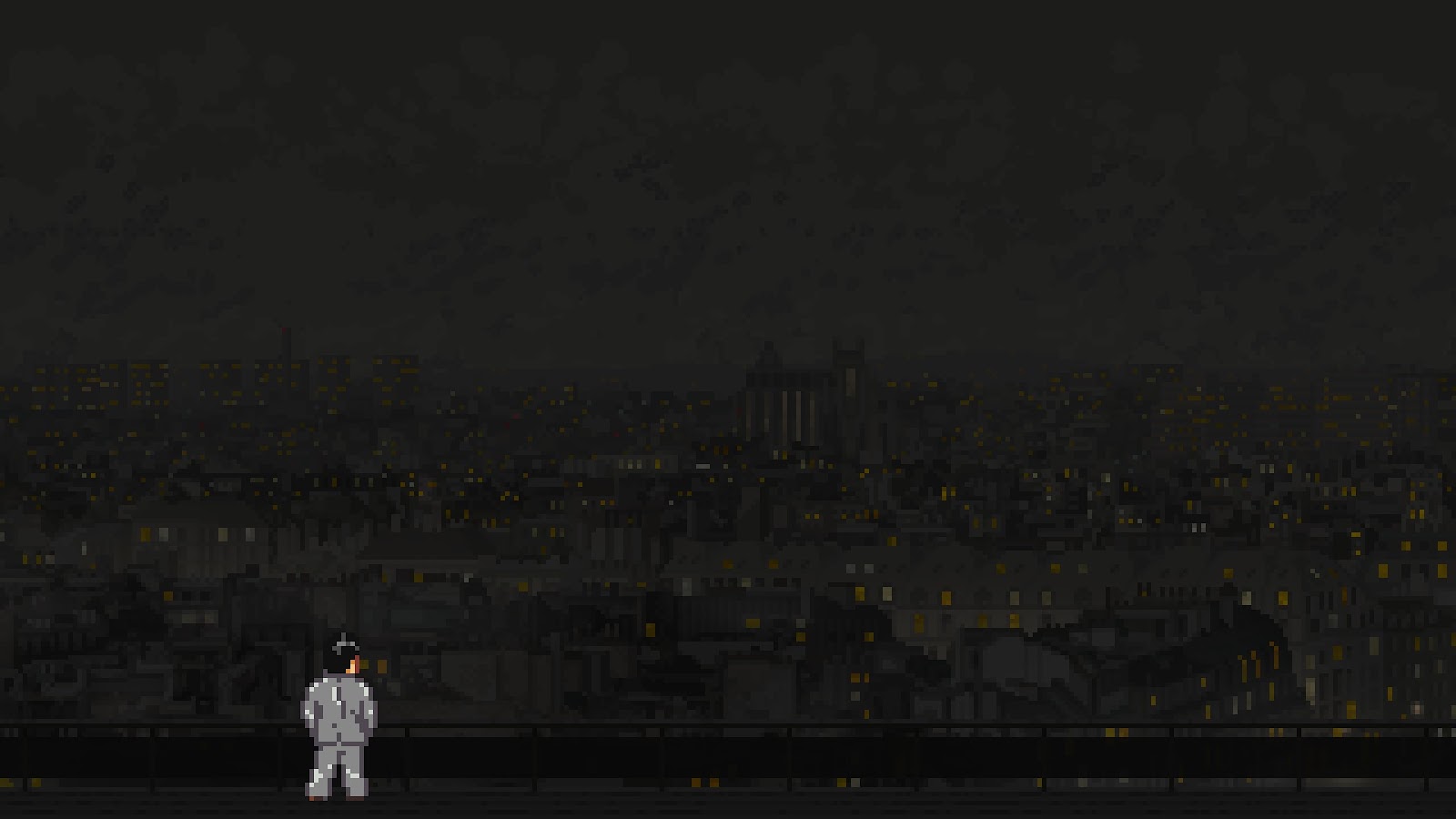
In 2020, yeo published his second 8-bit retro style game Arrest of a stone Buddha and in a more radical and minimalistic way, conducted his experiment on “duration” in the game. This more melancholy story about an assassin living in Paris 1976, is divided into two separate sectors which take turns forming a cycle: side-scroll, high intensity shoot’em-up; aimless wandering down on Paris’ streets. 


In the former, you have to discover some rules yourself: your bullets are always lethal and always kill, but an absurd amount of enemies will run towards you, facing and from behind like waves and you can’t reload, so the only option you have is to rip a new gun straight from the nearest enemies’ hands right when you’re empty. On top of that you can only “slow-walk”, and can only take a couple of hits, and unless you reach a “transition point”, enemies will infinitely spawn. So you “have to” shoot every enemy right when they appear and before they fire and keep moving forward while repeatedly turning back to shoot any enemies spawn behind you at the same time, intensity reaching hysteria.


In the latter, on the other hand, after briefly talking to the middleman you are thrown right into the dim Paris streets and “completely aimless”. On the street block containing only a drug store(selling sleeping pills), a cinema, a bar(selling smoke, to buy when you're empty), a clothing store, your own apartment, a roof of a high rise with an elevator which contains nothing and a museum, your only goal is to wander. But no matter what you do, or do not do, time will still pass, cycling day and night, until the next “hit”. Sleeping pills can fast forward a night, but most of the days you can’t buy it, and you also can’t take it before a certain time. Except for the middleman you briefly talk to after every mission, you have basically zero NPCs to actually “interact with” on these Paris streets, except for the minimum dialogue when you buy stuff. And there's almost nothing to accumulate. You have nothing to do with no one, they’re like phantoms. There’s only you, and time.


It is until I don’t know how many nights that, when Erik Satie’s Gnossiennes No.1 plays, it hits me: isn’t this Louis Malle’s Le Feu follet? We’re like Alain Leroy in the film, just rehabilitated and came out of a hospital(from hysteria), but still cut off from a meaningful world. The same tune from Le Feu follet appears here hence summons a familiar soul, and he also has a lover. In the game, there’s a door on the streets, if you go in you will fade into (which appears to be) a woman’s apartment. But every time you go in (if you are allowed in), you will only see the protagonist sitting on the edge of the bed, and on the bed “seems to be” a sleeping woman turning her back to us, or maybe it’s just nothing? We have no idea due to the pixelated art style. I’ve been there a full day in-game, but except for the clouds outside the window, nothing changed, except for the befalling of the night.